 Web HostingBudget-friendly shared hosting plans
 Domains SearchFrom .com to unique country domains, explore and register extensions worldwide.
 WordPress HostingPower your blog or business with WordPress hosting.
 Email HostingSimple, secure email hosting that helps you stay connected and professional.
 Reseller HostingStart your own hosting business with easy and reliable reseller hosting plans.
 AffiliateJoin our affiliate program and earn commissions every time you bring in new customers.
 cPanel HostingHosting powered by cPanel, the world’s most user-friendly control panel.
 Windows HostingBuilt for Windows applications and websites
 IN Domain PricesDon’t miss out on the best domain deals in India!
 WHOIS LookupFind out who owns a domain name with a quick and easy WHOIS search.
 Domain TransferTransfer your domain to us and enjoy reliable support every step of the way.
 .Com DomainGet the most trusted domain for worldwide credibility
 All TldsSearch and register domain extensions worldwide.
 SSL CertificatesProtect your website with trusted SSL certificates and keep customer data safe.
 VPS HostingPowerful virtual servers. Full root access. Reliable uptime.
 Managed VPS HostingNot a tech expert? Choose our fully managed VPS service.
 Dedicated ServersTake full power and total control of your own physical server.
 AI Website BuilderCreate stunning websites instantly with our easy AI builder.
 Online ShopBuild your eCommerce store easily, no coding, just growth.
 Web Design ServicesGet a website built for your brand and designed for your goals.
 Contact UsReach out to us for support or questions.
 SupportGet answers and how-to guides for all our services.
 BlogRead our latest blogs on web hosting, online business, digital marketing, and other helpful topics.
You want to start a website.
Budget’s tight. You see “free domain” offers everywhere. Tempting, right?
Here’s the truth upfront.
Free domains cost you more in the long run. They limit your growth. They hurt your credibility. They can disappear without warning.
On the other hand, paid domains cost ₹500-1,500 annually. That’s less than ₹125 per month. For that small investment, you get full ownership, professional branding, and complete control.
But I get it. When you’re just starting, every rupee matters, hence why the free option seems practical.
So, should you still choose the free domain or keep things pending till you have a budget to buy a paid domain?
Let’s find out in this guide.
What Is a Free Domain?
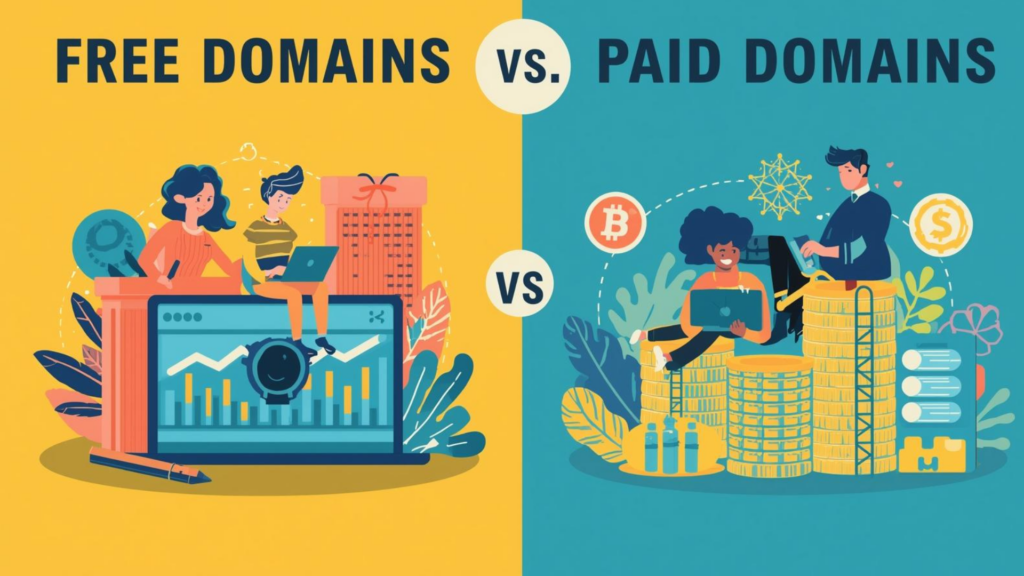
Free domains come in two main forms. That is
- Subdomain Type: This is the most common. Your website sits on someone else’s domain, like yoursite.ollit.com or yoursite.wordpress.com. Essentially, renting space on their platform.
- Free Domain Extensions: Some services offer free domain extensions like .tk, .ml, .ga, or .cf. These look like regular domains but come with major limitations that we’ll explore shortly.
So, how do you get free domains?
Website builders typically offer free subdomains when you sign up for their free plans.
Ollit, WordPress.com, Wix, Weebly, Shopify, they all provide this option.
For free extensions, services like Freenom used to provide them, though they’ve become less reliable recently.
Either way, remember that there’s nothing truly free. You pay with:
- Branding restrictions
- Limited functionality
- Platform lock-in
- No real ownership
In short, the platform controls your domain. They set the rules. They can change terms or shut down without notice.
What Is a Paid Domain?
A paid domain is one you register and own directly.
You pay an annual fee of around ₹500-1,500 for most domains in India. In exchange, you get full ownership for that period.
The common paid extensions in India are .com, .in, .net, .org, .co.in, which are all the standard professional extensions.
Industry-specific options like .tech, .store, and .design are also available.
So, what do you actually buy? It’s simple.
You’re leasing the domain name from a registrar for a set period, usually one year, renewable.
During that time, you have exclusive rights to use it. You control everything, including:
- Where it points
- What content appears
- Who has access
- DNS settings
- Email configuration
Typically, in India, you buy domain names from a registrar like Truehost, GoDaddy, or BigRock. They’re authorized retailers.
The registrar handles the registration process and provides management tools.
And as aforementioned, paid domains need annual renewal. If you don’t renew, you lose the domain.
But as long as you pay, the domain stays yours. Year after year.
Key Differences Between Free and Paid Domains
Free domains seem attractive initially. But they come with serious limitations that paid domains don’t have.
The differences affect everything. Your brand image, search visibility, ownership rights, and long-term viability.
Here’s how they compare:
| Factor | Free Domain | Paid Domain |
| Ownership | The platform owns it, not you | You own it completely |
| Brand image | Unprofessional, looks amateur | Professional, builds trust |
| Customization | Limited or none | Full control over everything |
| SEO value | Poor ranking potential | Full SEO benefits |
| Portability | Can’t transfer to another host | Transfer anywhere anytime |
| Generic or none ([email protected]) | Professional ([email protected]) | |
| Monetization | Restricted by platform | No restrictions |
| Ads | The platform may show its ads | You control all advertising |
| Security | Basic, shared SSL | Dedicated SSL, full security |
| Credibility | Low trust from users | High professional credibility |
The bottom line is that free domains work for temporary projects or personal experiments, while paid domains are essential for anything professional.
Now let’s explore each difference in depth.
1) Free vs Paid Domain: Ownership and Control
This is the most critical difference.
First, on a free domain, you don’t own the domain. The platform does.
For example, with “yoursite.wordpress.com,” WordPress owns the domain. You’re using their property.
So, they can:
- Change terms of service
- Shut down your site
- Limit your functionality
- Take the domain back
That means you have zero legal rights to the domain name itself.
On the other hand, on a paid domain, when you register the domain, you’re the legal owner during your registration period.
So, you control:
- DNS settings
- Nameservers
- Redirects
- Subdomains
- Email routing
Want to switch hosting providers? Easy. Your domain moves with you.
Want to sell your business? Your domain has value and can be transferred.
2) Free vs Paid Domain: Branding and Professionalism Impact
Thinking of using a free domain?
That can get you online, but just remember a domain name like “yourstore.wix.com” immediately signals amateur, no budget, not serious.
Customers notice. Competitors notice. Investors notice.
Would you trust a business with a free domain for a large order? Probably not.
However, a paid domain, like “yourstore.in” says established, invested, legitimate business.
It’s a subtle signal that improves customer trust, enhances brand consistency, and offers memorability.
3) Free vs Paid Domain: SEO and Search Visibility Differences
Google doesn’t explicitly penalize free domains. But it favors established, authoritative sites.
In other words, free domains have inherent disadvantages, including:
- Shared domain authority (you compete with thousands of other sites on the same domain)
- Lower trust signals
- Less likely to earn quality backlinks
In contrast, paid domains build their own authority over time. Every backlink, every quality content piece strengthens YOUR domain.
With free domains, you’re building authority for WordPress.com or Wix.com, not yourself.
4) Free vs Paid Domain: Security, Reliability, and Trust Factors
Paid domains easily support dedicated SSL certificates, so your site shows “https://” and the padlock icon.
Free domains, on the other hand, often share SSL or have limited security options. Some don’t support SSL at all.
And without SSL, browsers show “Not Secure” warnings. Customers leave. Google penalizes your rankings.
Next, paid domain owners choose their hosting provider. You can select reliable services with 99.9% uptime.
However, the free domains depend entirely on the platform’s reliability. If they have downtime, your site goes down, and you can’t do anything about it.
Also, unlike with free domains, with paid domains, you control backups, security protocols, and data storage.
Plus, the paid domains offer WHOIS privacy services, something free domains mostly lack. Thus, your personal information stays hidden from public lookup tools.
Limitations of Free Domains over Paid Domains
Every limitation of a free domain becomes an advantage with a paid domain.
Here’s a quick summary of the two:
| Aspect | Free Domain | Paid Domain |
| Ownership rights | The platform owns it; you can lose access anytime | You own it; complete control and security |
| Custom email | Not available or very limited | Professional email ([email protected]) |
| Monetization | Platform restrictions on ads/affiliate links | Full freedom to monetize however you want |
| Platform Ads | The platform displays its ads on your site | No forced advertising; you control all content |
| Storage & Bandwidth | Strict limits | Unlimited or high limits based on hosting |
| Customization | Limited templates and features | Full design freedom and functionality |
| Portability | Cannot transfer; start over if you leave | Transfer to any host; keep all your work |
| SEO potential | Limited due to shared authority | Full SEO benefits; build your own authority |
| Professional tools | Basic or no access to analytics, plugins | Access to all professional tools and integrations |
| Credibility | Appears amateur; hurts trust and conversions | Professional appearance; builds customer confidence |
| Support | Limited community support only | Dedicated support from the registrar and host |
| Long-term value | No asset value; can’t sell or transfer | Domain becomes a valuable asset over time |
Notice the pattern? Free domains restrict everything that matters for serious websites.
They’re designed for hobbyists, not businesses. For learning, not earning.
The best thing is that paid domains remove all these restrictions. You get the full internet, not a limited version.
Free Domain vs. Paid Domain: When Should You Choose?
Not everyone needs a paid domain immediately. Sometimes the free domain can be useful, in situations where paid domains are not the best fit.
For example, you should use a free domain when:
- Personal hobby blogs where you’re writing for friends and family. No business intent.
- Learning web development. You’re practicing skills, not building something permanent.
- Testing an idea for a few weeks. You haven’t validated the concept yet.
- Student projects or academic assignments with short-term requirements.
On the other hand, you will need a paid domain in:
- Professional portfolios showcasing your work to potential clients or employers.
- Freelancer website where credibility directly impacts your income.
- Blog or content site you plan to monetize through ads, affiliates, or sponsored content.
- Local business needing Google My Business and local SEO visibility.
- E-commerce stores because payment processors require proper domains.
- Startup or company building long-term brand value.
Thinking of starting free, then going paid later? It’s a viable approach, but you may create problems where you lose:
- All your search rankings
- Backlinks
- Social media followers
- Customer bookmarks and saved links
- Email subscribers who have your old address
So, the smart approach is if there’s any chance you’ll take this seriously, start with a paid domain.
₹1,000 per year is minimal compared to the cost of rebranding later.
Final Verdict: Free vs Paid Domain – Which Is Better for You?
Choosing between a free and paid domain depends on your goals.
For example, choose a free domain if you’re experimenting with no commitment.
Testing ideas, learning web basics, or running a personal hobby project with zero business intent.
On the other hand, choose paid domains if you’re serious about building something.
Any business activity. Any professional presence. Or, anything you want to last beyond a few months.
So, the real question it’s not “Can I afford a paid domain?” It’s “Can I afford to look unprofessional?”
In India’s competitive digital landscape, credibility matters. First impressions matter. Professional presentation matters.
And paid domain is the minimum investment for being taken seriously online.
Thankfully, at Truehost, we make domain registration simple and offer the best deals that help you get online without breaking the bank.
Ready to register your domain today? Get these mouth-watering discounts to save big!