 Web HostingBudget-friendly shared hosting plans
 Domains SearchFrom .com to unique country domains, explore and register extensions worldwide.
 WordPress HostingPower your blog or business with WordPress hosting.
 Email HostingSimple, secure email hosting that helps you stay connected and professional.
 Reseller HostingStart your own hosting business with easy and reliable reseller hosting plans.
 AffiliateJoin our affiliate program and earn commissions every time you bring in new customers.
 cPanel HostingHosting powered by cPanel, the world’s most user-friendly control panel.
 Windows HostingBuilt for Windows applications and websites
 IN Domain PricesDon’t miss out on the best domain deals in India!
 WHOIS LookupFind out who owns a domain name with a quick and easy WHOIS search.
 Domain TransferTransfer your domain to us and enjoy reliable support every step of the way.
 .Com DomainGet the most trusted domain for worldwide credibility
 All TldsSearch and register domain extensions worldwide.
 SSL CertificatesProtect your website with trusted SSL certificates and keep customer data safe.
 VPS HostingPowerful virtual servers. Full root access. Reliable uptime.
 Managed VPS HostingNot a tech expert? Choose our fully managed VPS service.
 Dedicated ServersTake full power and total control of your own physical server.
 AI Website BuilderCreate stunning websites instantly with our easy AI builder.
 Online ShopBuild your eCommerce store easily, no coding, just growth.
 Web Design ServicesGet a website built for your brand and designed for your goals.
 Contact UsReach out to us for support or questions.
 SupportGet answers and how-to guides for all our services.
 BlogRead our latest blogs on web hosting, online business, digital marketing, and other helpful topics.
Your ASP.NET application is ready to launch.
You need Windows hosting. But every provider claims to be the best, which brings confusion to deciding which is the best provider to choose.
Here’s how to choose:
Look for Windows Server 2019 or newer, Plesk control panel, MSSQL database support, servers in India, 99.9% uptime guarantee, and 24/7 support.
Plus, the provider’s pricing should be transparent with no renewal shocks.
Otherwise, the wrong Windows hosting cripples your application, slows performance, leads to database compatibility issues, and poses security vulnerabilities.
This guide breaks down what to look for when buying Windows hosting in India, explaining which features are essential and which ones are marketing fluff.
Things to Look For In Windows Hosting
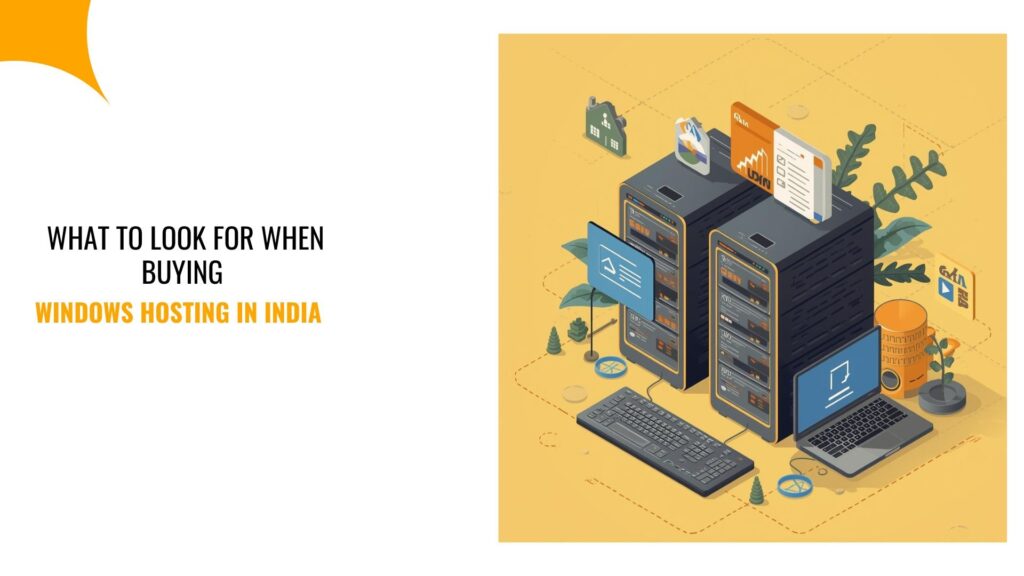
Windows hosting isn’t like Linux hosting.
It requires specific server configurations, different control panels, particular database systems, and support teams who understand Microsoft technologies.
Most mistakes happen because people treat Windows hosting like any other hosting. They focus on price, ignoring technical specifications, then wonder why their applications don’t work.
But avoid that, the following are features that separate quality Windows hosting from cheap services.
1) Windows Server Version and .NET Support
Your hosting provider’s Windows Server version determines what your applications can do.
Outdated versions create compatibility problems, security vulnerabilities, and missing features your code expects.
So, check which Windows Server version the hosting runs. Windows Server 2019 or 2022 should be standard now.
Otherwise, older versions like 2012 or 2016 lack newer security features and performance improvements.
More importantly, verify .NET Framework and .NET Core support. If your application requires .NET 6, 7, or 8, the hosting must support it.
In short, quality providers keep servers updated and document exactly what’s supported.
2) Control Panel
For Windows, Plesk is the industry standard.
Plesk gives you control over website management, database administration, email accounts, DNS settings, SSL certificates, and application installations.
Plus, the interface is clean and well-documented, and most Windows developers know Plesk.
And while some hosts offer custom control panels, most are inferior to Plesk.
Other hosting providers provide no control panel–just remote desktop access, which works for experienced administrators but creates problems for most users.
Therefore, when choosing a Windows hosting provider, ask, Can you manage hosting without contacting support for basic tasks?
If not, insist on Plesk unless you have specific reasons to use alternatives.
3) Database Support (MSSQL and MySQL)
Windows hosting typically supports Microsoft SQL Server (MSSQL). This is critical if your applications use MSSQL databases, which ASP.NET applications often do.
But MSSQL comes in different editions:
- MSSQL Express: Free edition with 10GB database size limit. Suitable for small applications and development.
- MSSQL Standard/Enterprise: Full-featured editions without limitations. Required for production applications with significant data.
So, check which MSSQL edition your hosting includes.
Many budget plans only offer Express, which won’t work for your application when the database exceeds 10GB.
Also, verify how many MSSQL databases you can create. Some plans limit you to one or two, which you need to decide based on your needs.
A good Windows hosting should also support MySQL databases for flexibility.
In summary, ask about database limits clearly, the number of databases, size restrictions, and edition specifics.
4) Performance and Server Location in India
Server location affects your website speed for Indian visitors. So, if your target audience is in India, your servers should be in India.
This is because far-located servers, like in the US or Europe, add 200-400ms latency, but the Indian servers reduce this to 10-50ms.
For ASP.NET applications, server response time is critical. Every database query is affected by server location and performance.
Beyond location, examine hardware specifications such as:
- RAM allocation: ASP.NET applications can be memory-intensive, so you need a minimum of 2GB for basic applications and 4GB+ for production.
- CPU resources: Are CPU cores dedicated or shared? Shared hosting often oversells CPU, causing performance problems during traffic spikes.
- SSD storage: All modern hosting should use SSDs. They’re 10-20x faster for database operations than traditional HDDs.
In short, cheap hosting oversells resources, and they pack too many customers on one server. However, quality hosting maintains reasonable customer-to-server ratios.
5) Security Features Included
Windows servers face specific security threats, and your hosting provider should implement protection by default.
Check for features like:
- Free SSL certificates: Essential for any website. Let’s Encrypt provides free SSL.
- Firewall configuration: Windows Firewall should be properly configured to block unnecessary ports.
- Regular Windows updates: Security patches are released monthly, so your host must apply them promptly.
- DDoS protection: Basic DDoS mitigation should be included.
- Malware scanning: Regular scans detect compromised files before they cause damage.
- Automatic backups: Daily backups protect against data loss, so verify backup retention and the restoration process.
At minimum, demand SSL, firewall protection, and regular updates.
But also, security requires ongoing maintenance. Thus, your host should handle that professionally.
6) Scalability and Upgrade Options
Your hosting needs will change.
Traffic increases. Application complexity grows. Resource requirements expand.
That means you should check the provider’s upgrade path, such as.
- Vertical scaling: Adding more RAM, CPU, or storage. It should be straightforward with minimal downtime.
- Horizontal scaling: Moving to VPS or dedicated servers when needed. The migration should be supported.
Some hosts make upgrades difficult, where you must completely migrate to a new plan.
But reliable Windows hosting providers offer smooth scaling. You add resources through your control panel, and sites remain operational during transitions.
7) Uptime Guarantee and Reliability
Uptime is the percentage of time your hosting remains operational.
For example, 99.9% uptime means your site is down for about 8.76 hours per year, but 99.5% uptime means it’s 43.8 hours annually.
Therefore, look for providers offering a 99.9% uptime guarantee minimum.
But guarantees mean nothing without enforcement.
What compensation do you receive if they miss the guarantee? Many offer service credits based on downtime.
So, also read the Service Level Agreement (SLA) carefully and unveil what counts as downtime.
Beyond guarantees, check real-world reliability. Read customer reviews and look for patterns of downtime complaints.
8) Customer Support Quality and Availability
You will need support.
Remember, Windows hosting involves complex configurations, so issues arise and questions need answers.
So, with customer support on standby, everything becomes easy.
But the support quality varies dramatically between providers, which means you should check for:
- Availability: 24/7 support is essential as server issues don’t happen only during business hours.
- Response time: How quickly does support respond? Check reviews for actual response times.
- Communication channels: Phone, chat, email, and ticket systems.
- Technical expertise: Does support understand Windows-specific issues? ASP.NET configurations? MSSQL problems?
Many budget hosts outsource support to general technicians who lack Windows expertise.
So, test the customer support before buying. You can submit a pre-sales question and see how quickly they respond.
Also, check if the support is included or does it costs extra.
Either way, quality support saves hours of troubleshooting, which is worth paying slightly more.
9) Pricing, Renewals, and Hidden Costs
Advertised rates often don’t match what you’ll actually pay. So, check for factors like:
- Promotional vs. Regular Pricing: “Windows Hosting at ₹149/month!” looks attractive, but the renewal price might jump to ₹599/month. So, always check renewal pricing by calculating your cost over 2-3 years, not just the first year.
- Domain registration costs: Some plans include a free domain first year, but ask what the renewal cost is before getting trapped in higher fees.
- SSL certificate fees: Should be free with Let’s Encrypt, unless you need a premium SSL for solidified security.
- Backup costs: Are backups included or extra? Some hosts charge, while others offer free.
- Migration fees: Do they charge for migration services, or is it a free service? You need to find out before committing.
Add up all these costs and compare the total annual cost between providers.
At Truehost, we maintain transparent pricing. No hidden fees, and renewal rates are clearly stated.
10) Free Migration and Add-On Services
Switching hosts is stressful.
Good Windows hosts offer free migration assistance. In other words, their team handles the technical work for you.
This saves hours and reduces migration errors.
So, check what’s included, including website files and databases, email accounts, DNS configuration, SSL certificate installation, and application testing.
Beyond migration, look at value-added services such as:
- Site builder tools: If you need to create sites beyond your ASP.NET applications.
- Email hosting: Professional email with your domain.
- Staging environments: Test changes before pushing to production.
But also, don’t pay for features you won’t use.
Final Words
Windows hosting is specialized.
The 10 factors we’ve covered aren’t negotiable. They determine whether your hosting works.
Current Windows Server versions, Plesk control panel, full database support, Indian server locations, robust security, clear scaling, reliable uptime, expert support, and transparent pricing all make a good Windows hosting provider.
Don’t overfocus on one factor, assuming others.
For example, considering a cheap hosting provider, forgetting that a poor hosting costs far more in downtime and wasted time.
Thankfully, at Truehost, we’ve built Windows hosting specifically for Indian developers and businesses.
You get current Windows Server versions, Plesk included, MSSQL and MySQL support, and fully optimized Servers.
Ready to launch? Explore these Truehost Windows hosting plans.